
Works bulletinv0.9.9 ·
The Smart Armoury Update
35 ready-made smart munitions - bombs, missiles, re-entry vehicles, barrel and mortar rounds, every one wired with real electronics - plus a first Career job of its own, named tabs, an electronics round image and new staff portraits.
- smart munitions
- electronics
- round designer
- career
- tutorial
- round images
- staff
Thirty-five new munitions, and every one of them thinks for itself.
The smart armoury
Sandbox › your designs
Your design list now holds 35 ready-made munitions, each built around one trick of the electronics: sensors, chips and drawn wires doing the work, wired the way you'd wire them yourself. Open any of them in the designer to see how it's done, then change it, rename it or delete it. They're ordinary designs. A Career firm gets the ones its research already covers.
Bombs. A retard bomb whose altimeter opens a tail parachute at 45 m, so it comes down slow and nose-first at about 3 m/s. An airburst bomb with a proximity probe that sets it off 2 m above the ground. A thermobaric bomb that sprays its fuel at 6 m and lights the cloud 15 ms later. A bunker buster that goes through the roof and waits for the room. A laser-guided bomb with fins that fold out after release: dropped from 100 m, it landed 2 m from the laser dot, where the same bomb without the laser came down 47 m short. And a cluster dispenser that opens at 40 m and scatters 20 bomblets.
Missiles. A top-attack anti-tank missile whose chip only fires when it has hit something and steel is within 2.5 m: it flies through a timber wall without firing and puts its jet into the armour behind. A heat-seeker that goes for fires and hot engines, with a self-destruct at 8 s. A tandem bunker buster whose small front charge opens the wall before the main charge follows it in. And a two-stage missile that drops its booster, lights a second motor, and throws flares when an anti-air missile closes in.
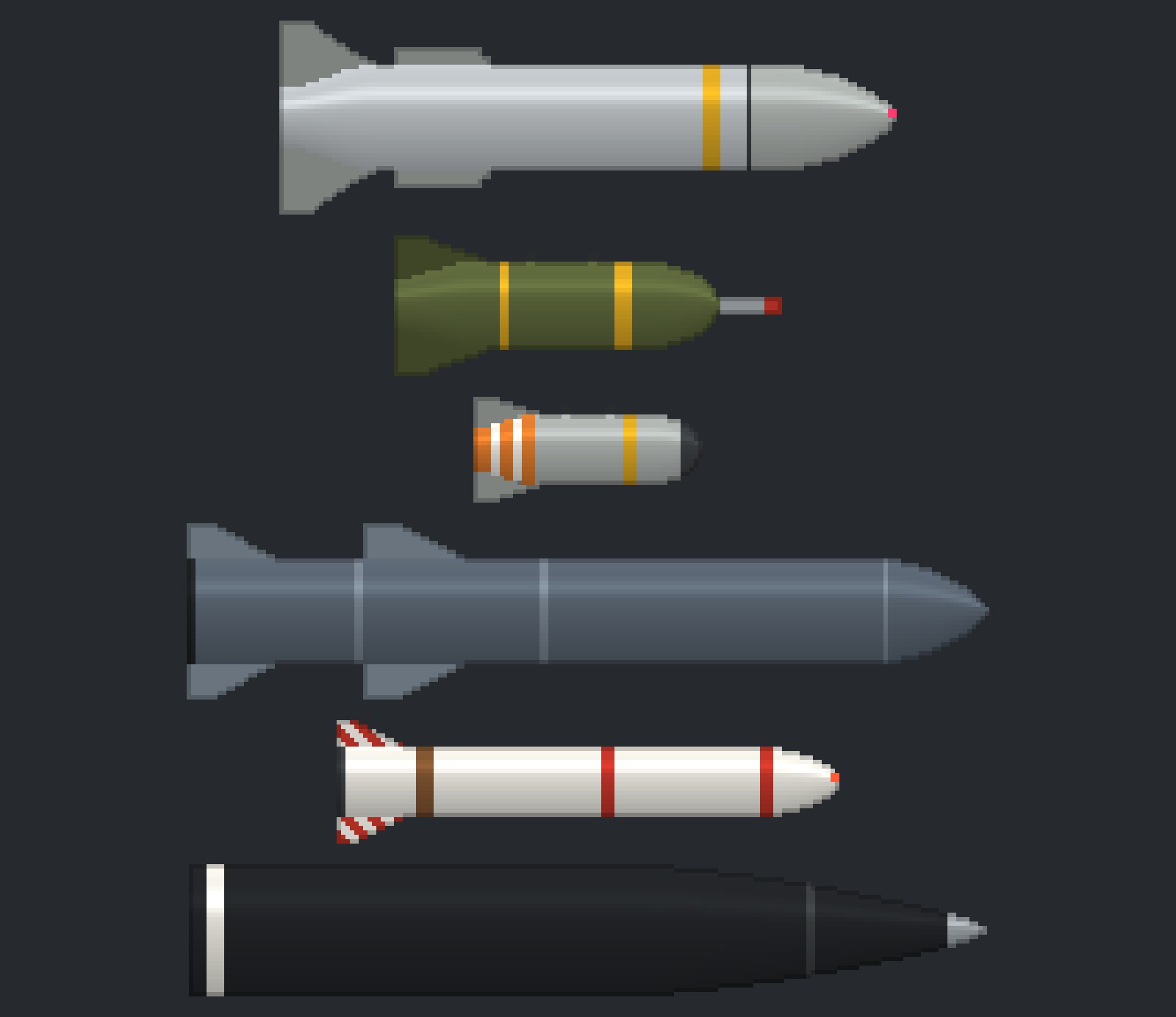 Six of the new bombs and missiles: a light grey laser-guided bomb with folded fins along its back, an olive airburst bomb with a red-tipped probe, a small grey retard bomb with an orange-striped tail, a navy two-stage missile with two sets of fins, a white heat-seeker with red bands, and a black MIRV warhead
Laser-guided bomb, airburst bomb, retard bomb, two-stage missile, heat-seeker, MIRV.
Re-entry vehicles. A MIRV that splits into three warheads at 150 m. A penetrator that goes off the moment it breaks into a room, an airburst that fires 23 m up, an earthquake warhead that goes off 2.5 m underground, and a precision warhead with a laser seeker that came down 0.5 m from its dot.
Barrel and mortar rounds. Twenty, for every barrel and both mortars: steel, Tungsten, Depleted uranium and a Tungsten carbide dart in a sabot; buckshot that bursts into 20 pellets as it leaves the barrel; timed flak, proximity flak, and shrapnel that throws 92 steel balls forward; a void-fuzed shell that goes off inside the room; a laser-guided shell and a laser-guided mortar bomb; a rocket-assisted shell whose motor lights at the top of its climb; HESH that knocks a 43 cm scab off the back of a steel plate; thermite, illumination flares, smoke and a top-attack shaped charge.
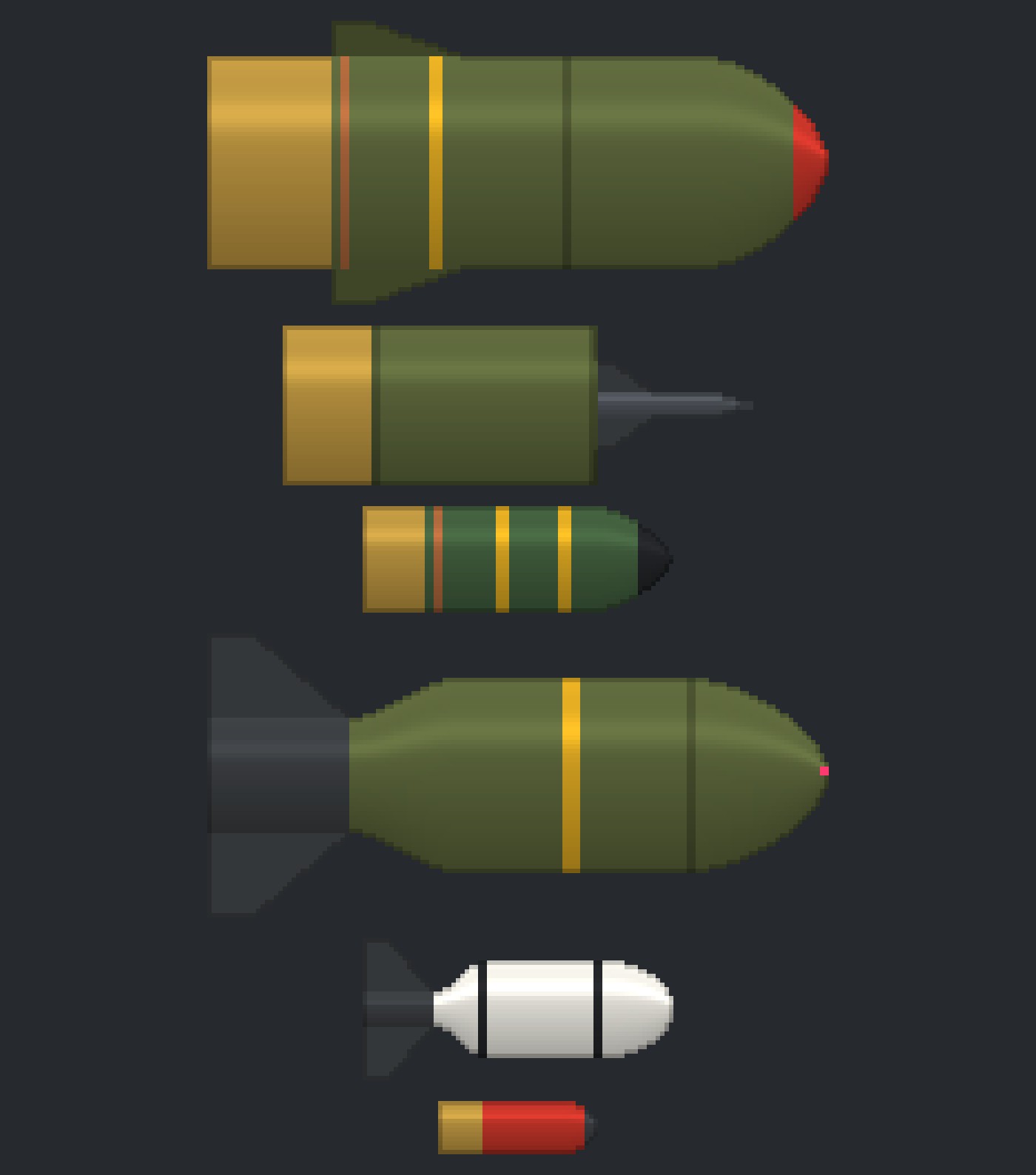 Six of the new rounds: an olive top-attack shell with a brass case and a red tip, a Tungsten carbide dart in an olive sabot, a green void-fuzed shell, an olive guided mortar bomb, a white illumination bomb, and a red buckshot shell
Top-attack 32, APFSDS dart 24, Void HE 16, Guided M32, Illumination M16, Buckshot 8.
A first job of its own
Career › the foreman's tour
The foreman's tour now always walks you through the same job: Proving Ground, for the Ridgeline Gun Club. It's a Standard 16 test, one concrete guard hut at 40 m and a quarter of it to knock down, with a budget of $220 a round. The Slug 16 and the HE 16 a new firm starts with both pass it. Before, the tour could hand you a job for a barrel you hadn't researched yet.
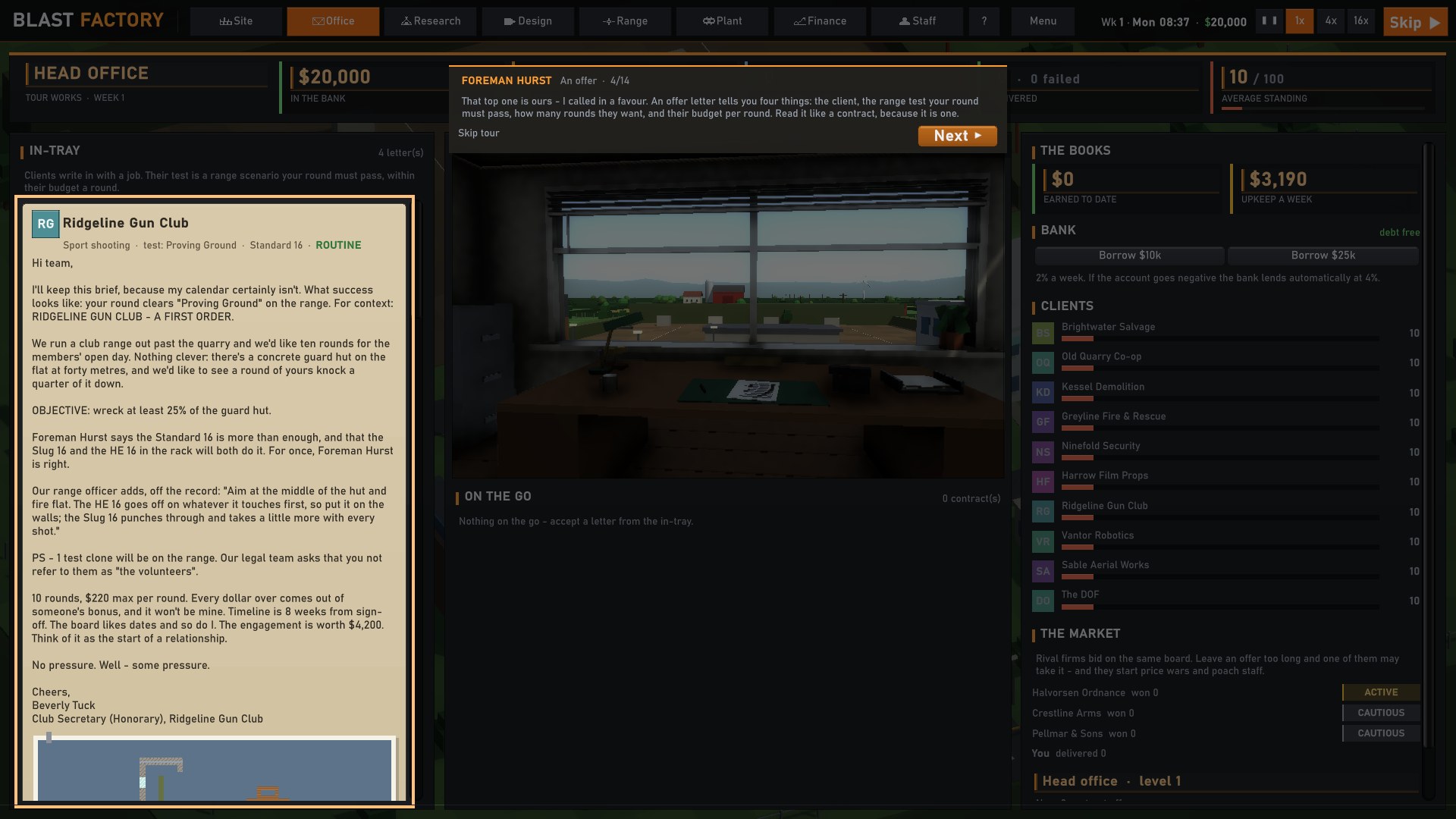 The Head Office in-tray with the Ridgeline Gun Club's letter for Proving Ground - Standard 16, 10 rounds, $220 a round, $4,200 - lit up while Foreman Hurst explains the offer
The tour's first letter.
Named tabs, new faces
Career › the top bar, and Staff
The tabs along the top say where they go again - Site, Office, Research, Design, Range, Plant, Finance, Staff - instead of shrinking to a number whenever the full names don't fit. They only drop to numbers on a very narrow window.
Your staff have new ID photos, drawn the same way as the people on the plant floor and the compound: fitters in hard hats and hi-vis, researchers in lab coats (some in goggles), engineers in their work shirts.
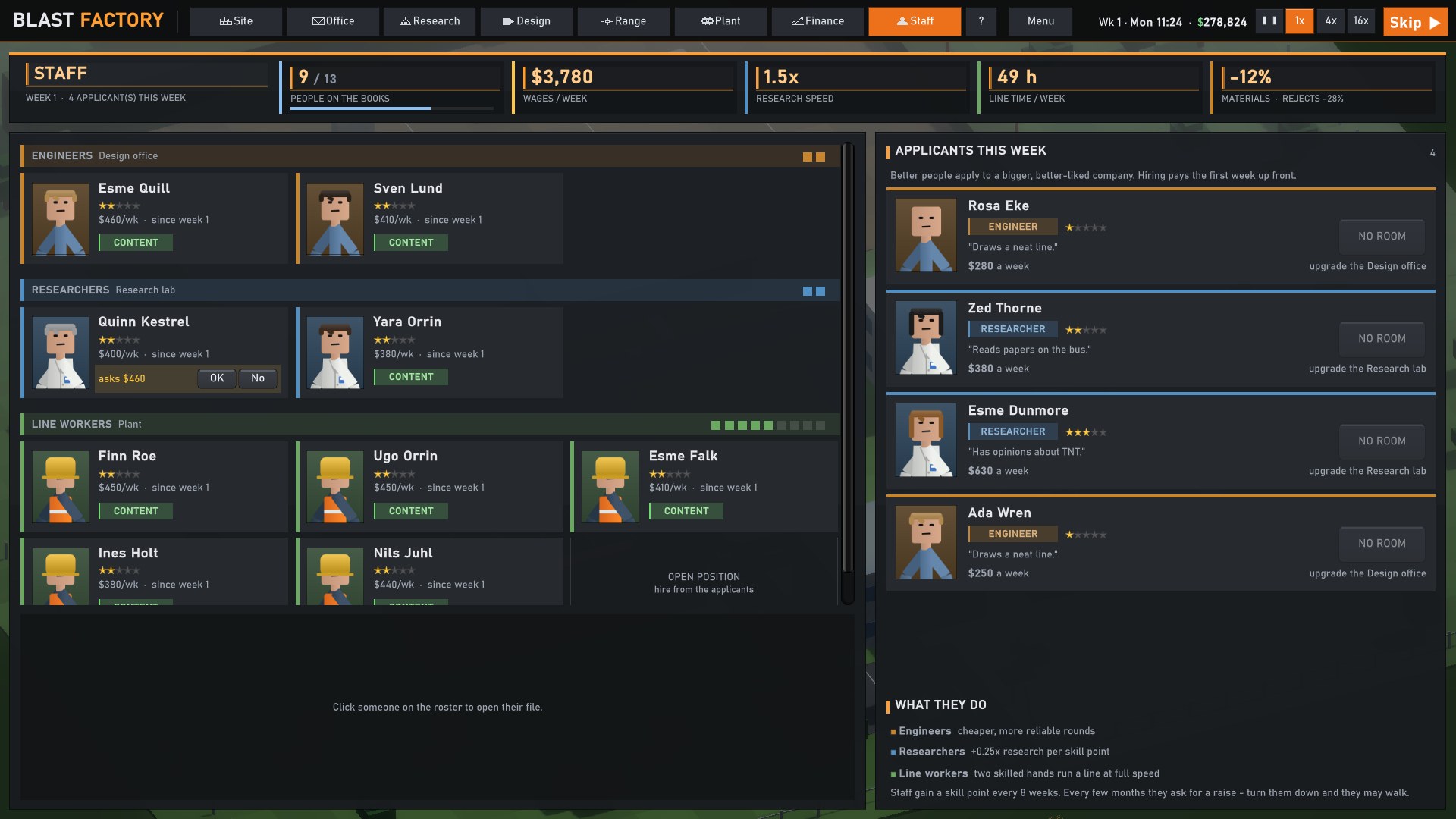 The Staff room: engineers in blue shirts, researchers in white lab coats and line workers in yellow hard hats and orange hi-vis, under the top bar's named tabs
The staff room, and the named tabs above it.
The electronics, on their own
Round Designer › Export image
A round with electronics now gets one more round image: its electronics on their own. The rest of the round fades back, and the parts, chips and wires stand out in full colour, each part with its own icon and the labels naming only the electronics. Every round image now shows parts with their icons too, instead of plain coloured squares.
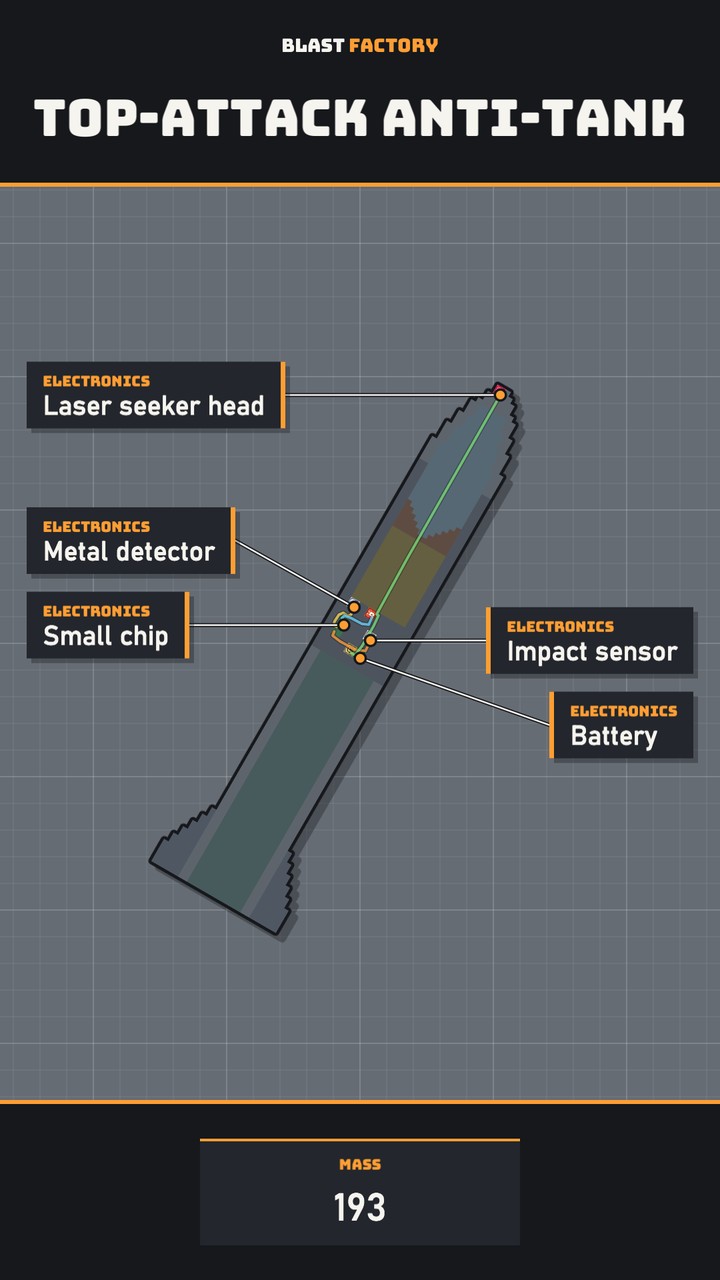 The electronics image of the top-attack anti-tank missile: the body faded to grey, a green wire running from the laser seeker in the nose back to the electronics bay, with labels for the laser seeker head, metal detector, small chip, impact sensor and battery
The anti-tank missile's electronics, labelled.
Fixed
- Wiring: A wire running through a gas, liquid or powder tank, or across another part, no longer breaks when the tank is sprayed out or drains, or when the part fires. Spraying an atomiser's tank used to cut every wire through it, so a void sensor wired to a chip would report "not wired" mid-flight.
- Wiring: When a round breaks apart, a wire with both ends on one piece now stays with that piece, even where it crossed a part that came loose.
- Staff: Let go of Larry.
Wire it up. See you on the range.